
How to Choose the Right Reformer Pilates Studio – Especially If You Have an Injury, Health Condition or Disability

Reformer Pilates has become incredibly popular, and with new studios and classes appearing everywhere, we now have more choice than ever before.
But here's the thing:
Not all Reformer Pilates classes are the same.
If you're fit, healthy and simply looking for a good workout, your decision might come down to location, timetable, price and whether you like the atmosphere.
But if you have back or joint pain, a previous injury, arthritis, osteoporosis, reduced mobility, a disability, a neurological condition, or you're returning to exercise following surgery, there are a few more things worth considering before you book your first class.
As a Chartered Physiotherapist and Reformer Pilates instructor, I regularly meet people who want to exercise but aren't quite sure what is safe or appropriate for their body.
So, before you book that class, here are a few things I think you should look for.
1. Who is actually teaching you?
Don't be afraid to ask about your instructor's qualifications and experience.
Pilates instructors come from many different training backgrounds. If you have an injury, disability or medical condition, it can be particularly helpful to work with someone who has experience in rehabilitation or working with people with additional needs.
A good instructor should also recognise when something falls outside their professional scope and when you may need advice from an appropriate healthcare professional.
Qualifications matter – but so does experience.
2. How big is the class?
This is a big one.
In a large Reformer class, it can be difficult for one instructor to watch everyone's technique, make individual corrections and offer different versions of exercises.
That's particularly important when someone has pain, reduced mobility or an injury.
Smaller classes allow an instructor to pay much closer attention to how you're moving and make adjustments where necessary.
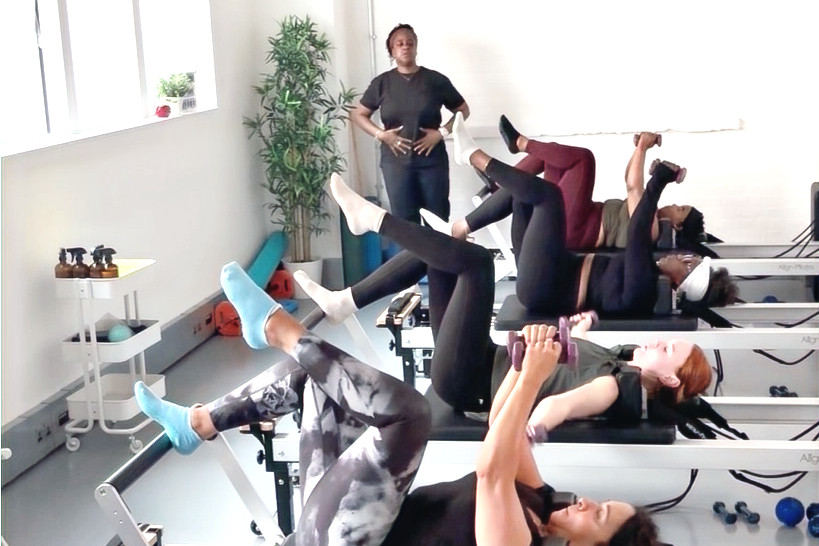
At JP Studios, our Reformer Pilates classes have a maximum of four people.
That's intentional.
It allows us to keep the social, motivating atmosphere of a group class while still providing much more individual attention.
3. Does anyone ask about your health before you start?
This is something I think people should pay much more attention to.
Before joining a class, you should have an opportunity to tell the studio about relevant injuries, operations, medical conditions, pain or movement limitations.
If you tell an instructor that you have ongoing back pain, for example, they should want to know a little more.
Simply saying “Pilates is good for backs” isn't enough.
The same applies if you have arthritis, osteoporosis, a joint replacement, a neurological condition or you're recovering from surgery.
The instructor doesn't necessarily need your entire medical history – but they do need enough relevant information to help you exercise appropriately.
THE EXERCISE SHOULD FIT THE PERSON —
NOT THE PERSON FIT THE EXERCISE.
4. Can the exercises be adapted to you?
There isn't one version of an exercise that's right for everybody.
Something that works beautifully for the person on the Reformer next to you might be completely inappropriate for you.
And that's absolutely fine.
A good instructor should be comfortable modifying exercises, changing resistance, altering your position or giving you a completely different exercise where necessary.
You should never feel as though you're failing because you're doing something differently from everyone else.
5. Is “beginner friendly” actually beginner friendly?
“Suitable for beginners” can mean very different things from one studio to another.
If you've never used a Reformer before, there's actually quite a lot to learn.
Springs. Straps. Carriage. Footbar. Headrest. Getting on. Getting off.
And occasionally wondering why the carriage has just moved when you weren't expecting it to! 😄
Your first class shouldn't involve desperately trying to copy the person next to you while hoping nobody notices that you have absolutely no idea what's going on.
Ask how beginners are introduced to the equipment and whether the instructor will have time to help you.
🎵 A quick word about the music...
While we're discussing the studio environment, there is one other important matter we should clear up.
The instructor is in charge of the music.
And no, unfortunately, we cannot accommodate everyone's individual music preferences. 😂
One person wants 90s R&B. Someone else wants Afrobeats. Someone wants relaxing music. And somebody inevitably doesn't like any of the above.
Therefore, in the interests of studio harmony, the instructor has the final say on the playlist.
You are, of course, completely entitled to judge our musical choices silently from your Reformer.
Thank you for your understanding. 😄
Now, back to the serious stuff...
6. What happens if something hurts?
Exercise can be challenging. Muscles working hard, fatigue and effort are all part of exercise.
Pain is different.
If you experience sharp, unusual or increasing pain, you should feel comfortable telling your instructor.
Your instructor should be able to stop, look at what you're doing and decide whether the exercise needs to be modified, replaced or stopped.
“Just push through it” isn't always the right answer.
Particularly if you already have an injury or medical condition.
7. Would you be better starting with a 1:1?
Group classes aren't necessarily the best starting point for everybody.
If you have a significant injury, complex medical history, recent surgery, considerable pain, reduced mobility or you're simply very nervous about exercising, an individual session may be a better introduction.
A 1:1 gives you time to discuss your concerns, understand the equipment and learn how your body responds to different movements without feeling that you need to keep up with a class.

You may then be able to progress into group sessions when you feel ready.
And sometimes, one or two individual sessions are all that's needed to give someone the confidence to join a group.
8. Has the studio worked with people like you before?
Ask. It's a completely reasonable question.
If you have Parkinson's disease, multiple sclerosis, osteoporosis, arthritis, persistent back pain, a joint replacement or another condition that affects your movement, ask whether the instructor has experience working with people with similar needs.
They don't necessarily need to have worked with your exact diagnosis before.
What matters is that they understand their professional limitations, can adapt appropriately and know when further clinical advice may be required.
Your Reformer Pilates Checklist: 8 Questions to Ask Before You Book
Before choosing a Reformer Pilates studio, ask:
1. Who will be teaching me and what are their qualifications?
2. How many people will be in the class?
3. Will you ask about my injuries and medical history?
4. Can exercises be adapted for my condition or disability?
5. Is the class genuinely suitable for someone who has never used a Reformer?
6. What happens if an exercise causes pain?
7. Would I benefit from a 1:1 session before joining a group?
8. Do you have experience working with people with my particular needs?
And perhaps a ninth...
9. Who controls the playlist? 🎵
We've already covered that one. 😄
Reformer Pilates for Injuries: Choose Somewhere You Feel Comfortable
A Pilates studio shouldn't feel intimidating.
You should feel comfortable asking questions, telling your instructor when something doesn't feel right and working at a level that's appropriate for your body.
Having an injury, disability or long-term health condition doesn't automatically mean Reformer Pilates isn't for you.
It may simply mean that choosing the right environment and the right professional is particularly important.
At JP Studios Pilates & Physio, we combine Reformer Pilates with physiotherapy and rehabilitation experience.
Our classes are deliberately kept small, with a maximum of four people, allowing us to provide more individual attention while maintaining the friendly atmosphere of a group class.
We also offer 1:1 sessions for people who would benefit from a more individual approach before progressing into classes.
If you're unsure whether Reformer Pilates is appropriate for you, get in touch before booking. Tell us a little about what's going on and we'll help you decide the most appropriate place to start.
Ready to try Reformer Pilates? View our classes and introductory offer.
JP Studios Pilates & Physio
Clinical Reformer Pilates • Physiotherapy • Rehabilitation
West London
And yes — we'll choose the music. 🎵

Comments